
How Climate Change Affects Agriculture and What Farmers Can Do About It Introduction. Climate change continues to alter the way farmers produce food across the globe. Rising temperatures, unpredictable weather patterns, and extreme conditions threaten crop yields, soil health, and water availability. In this post, we’ll explore how climate change affects agriculture and outline proactive strategies farmers can use to adapt and build resilience.
Keywords: climate change and agriculture, effects of climate change on farming, climate-smart agriculture, adaptation strategies in agriculture
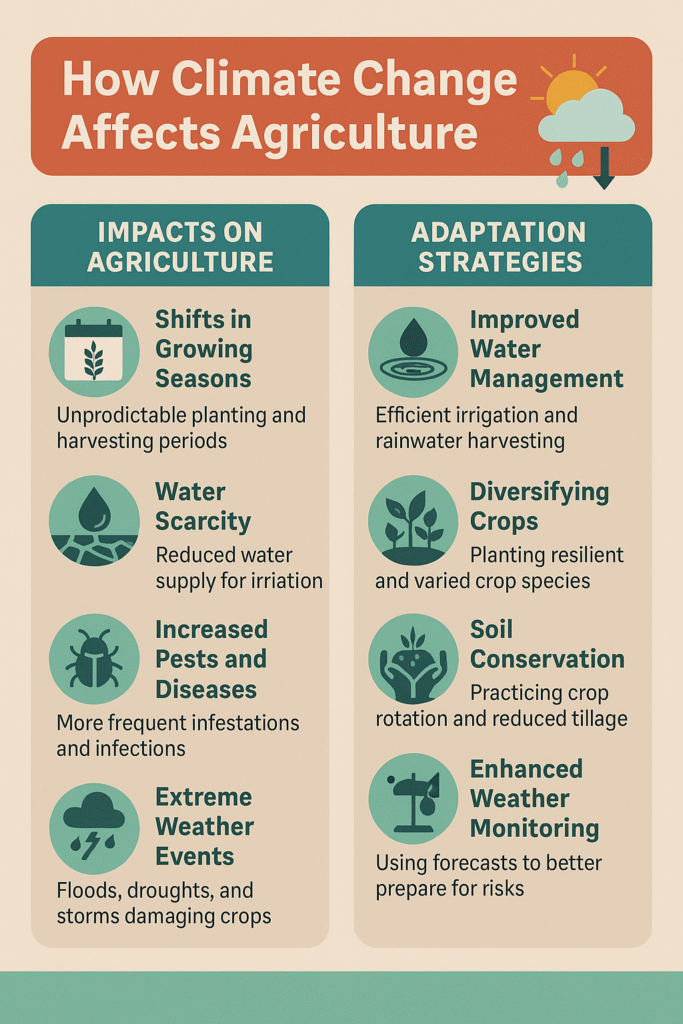
How Climate Change Affects Agriculture
- Irregular Rainfall Patterns
- Farmers depend on regular rainfall to grow crops. When rainfall becomes unpredictable, it disrupts planting schedules and reduces yields.
- Rising Temperatures
- High temperatures stress crops and livestock. Some crops, like maize and wheat, suffer yield losses as the heat rises.
- Extreme Weather Events
- Floods, droughts, hurricanes, and heatwaves cause significant damage to farmland, destroy infrastructure, and reduce food security.
- Soil Degradation
- Heavy rainfall and drought accelerate erosion and deplete organic matter, making soil less fertile.
- Pests and Diseases
- Warmer climates encourage the spread of pests and plant diseases into new regions, putting more crops at risk.
What Farmers Can Do to Adapt
- Practice Climate-Smart Agriculture
- Adopt methods like conservation tillage, cover cropping, and integrated pest management.
- These techniques improve soil health and reduce carbon emissions.
- Use Drought-Resistant Crops
- Plant improved varieties that tolerate heat and drought. These crops maintain yields even under extreme conditions.
- Implement Efficient Irrigation Systems
- Use drip or sprinkler irrigation to conserve water and reduce dependency on rainfall.
- Diversify Farm Enterprises
- Add livestock, vegetables, or agroforestry to spread risk and stabilize income.
- Adopt Weather Forecasting Tools
- Access real-time weather data to guide planting, harvesting, and irrigation decisions.
- Build Soil Resilience
- Apply compost and organic fertilizers. Encourage crop rotation and mulching to maintain healthy, productive soils.
- Engage in Community-Based Adaptation
- Collaborate with local farmers, cooperatives, and extension services to share knowledge and build support networks.
Long-Term Mitigation Strategies
- Plant trees and adopt agroforestry systems.
- Reduce greenhouse gas emissions from livestock and machinery.
- Transition to renewable energy sources like solar-powered water pumps.
- Participate in carbon credit programs to get rewarded for sustainable practices. here a post on farm power sources
Conclusion
Farmers stand on the frontlines of climate change. By adopting climate-smart agriculture and implementing practical adaptation strategies, they can continue to feed communities, preserve ecosystems, and secure their livelihoods. Climate change challenges us all—but with the right tools, farmers can lead the way in building a resilient and sustainable food future.
Learn more about sustainable farming at fabioclass.com.
Originally posted 2025-07-12 18:16:10.