
Differentiation: The Biological Process That Creates Specialized Cells
Explore the process of differentiation in biology — how unspecialized cells transform into specialized cell types for growth, repair, and development.
Table of Contents
- Introduction to Differentiation
- Meaning and Definition of Differentiation
- History and Discovery of Cellular Differentiation
- The Importance of Differentiation in Biology
- Mechanism of Differentiation
- Genetic Control of Differentiation
- Role of DNA and Gene Expression
- The Process of Differentiation in Embryonic Development
- Cellular Determination and Commitment
- Differentiation in Plants vs. Animals
- Factors Affecting Differentiation
- Stem Cells and Their Role in Differentiation
- Types of Stem Cells
- Differentiation and Tissue Formation
- Dedifferentiation and Redifferentiation
- Abnormal Differentiation and Diseases
- Applications of Differentiation in Medicine and Biotechnology
- Regenerative Medicine and Differentiation
- Summary of Differentiation
- Frequently Asked Questions (FAQ)
Introduction to Differentiation
Differentiation is a fundamental biological process that allows an organism to develop from a single cell — the zygote — into a complex system composed of specialized cells, tissues, and organs. This process gives rise to muscle cells, nerve cells, skin cells, and other specialized types, each performing unique functions necessary for life.
Through differentiation, identical genetic material in each cell is expressed in different ways, creating diversity among cell types. This selective gene expression determines the cell’s structure, function, and life cycle. Without differentiation, multicellular organisms would remain as undifferentiated masses of identical cells incapable of performing complex biological tasks.
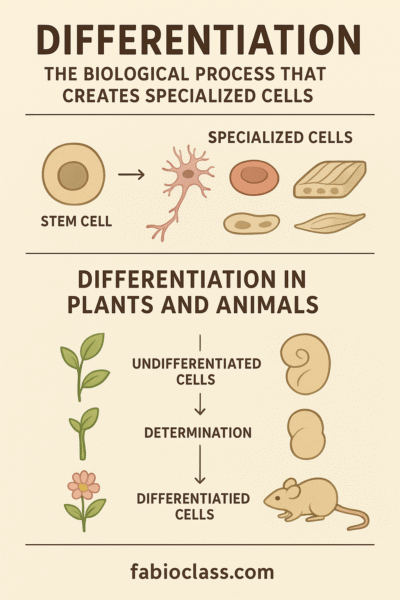
Meaning and Definition of Differentiation
In biology, differentiation refers to the process by which unspecialized or less specialized cells develop into distinct cell types with specialized structures and functions.
For example, stem cells in an embryo can differentiate into muscle cells, neurons, or blood cells depending on signals they receive from their environment and genetic programming.. more on genetics here
In simple terms, differentiation means cell specialization — where a general-purpose cell adopts a specific role to perform unique biological functions.
History and Discovery of Cellular Differentiation
The concept of differentiation traces back to early embryology. Scientists like Wilhelm Roux (1850–1924) and Hans Driesch (1867–1941) conducted experiments showing that early embryonic cells have different developmental potentials.
The discovery of stem cells and advancements in molecular genetics in the 20th century provided deeper insight into differentiation. The realization that all cells contain the same DNA but express it differently revolutionized our understanding of how a single fertilized egg gives rise to an entire organism.
Today, differentiation remains a central topic in developmental biology, genetics, and regenerative medicine. more on genetic materials here
The Importance of Differentiation in Biology
Differentiation is crucial for life because it allows for division of labor within organisms. Different cell types perform specific roles that contribute to survival and homeostasis.
Key Roles of Differentiation:
- Formation of tissues and organs: Specialized cells combine to form tissues like muscle, bone, and blood.
- Growth and development: Differentiation enables embryos to develop into fully formed organisms.
- Repair and regeneration: Some cells can redifferentiate to repair damaged tissues.
- Functional diversity: It allows for the existence of various cell types such as neurons, red blood cells, and epithelial cells.
Without differentiation, multicellular organisms would not be able to maintain complex biological systems or perform coordinated functions.
Mechanism of Differentiation
Differentiation occurs through a series of genetic and biochemical changes within the cell. These changes alter the expression of specific genes, leading to the production of proteins that determine cell structure and function.
Stages of Differentiation:
- Determination: The cell’s fate is decided, although its appearance has not yet changed.
- Differentiation: The cell develops specialized characteristics and functions.
- Maturation: The cell achieves full functionality and stability.
During this process, some genes are activated while others are suppressed, controlling which proteins are produced. This selective gene expression shapes the cell’s identity.
Genetic Control of Differentiation
Every cell in a multicellular organism contains the same DNA, but not all genes are active in every cell. Differentiation is controlled by gene regulation — the process that turns specific genes “on” or “off.”
Transcription factors, epigenetic modifications, and signal molecules play vital roles in regulating gene expression during differentiation. Environmental cues such as hormones, growth factors, and cell-to-cell interactions also influence which genes are expressed.
This genetic control ensures that liver cells, for example, express genes for detoxification enzymes, while neurons express genes for neurotransmitters.
Role of DNA and Gene Expression
DNA carries all the genetic information needed to build an organism. However, differentiation depends not on having different DNA, but on how that DNA is read and expressed.
During differentiation:
- Specific genes are transcribed into messenger RNA (mRNA).
- The mRNA is translated into proteins.
- Proteins determine the cell’s structure, function, and behavior.
The cell’s microenvironment, chemical signals, and position in the organism all affect gene expression. Thus, gene expression patterns are what make a muscle cell different from a neuron, even though they share the same genetic code.
The Process of Differentiation in Embryonic Development
Differentiation begins shortly after fertilization. The zygote divides to form a blastula, composed of identical cells. As development continues, these cells start to specialize through a process called embryonic differentiation.
Major Stages:
- Cleavage: Rapid cell divisions without growth.
- Blastulation: Formation of the blastula.
- Gastrulation: Cells begin to migrate and form germ layers — ectoderm, mesoderm, and endoderm.
- Organogenesis: The germ layers differentiate into tissues and organs.
Each germ layer gives rise to specific cell types — for example, the ectoderm forms skin and nervous tissue, while the mesoderm forms muscles and the circulatory system.
Cellular Determination and Commitment
Before differentiation occurs, a cell must become determined — meaning its fate is fixed even if its environment changes.
Determination is often influenced by:
- Chemical gradients (morphogens)
- Cell-to-cell signaling
- Epigenetic modifications
Once determined, the cell is committed to becoming a specific type, such as a nerve cell or a red blood cell.
Differentiation in Plants vs. Animals
While the principle of differentiation is universal, it occurs differently in plants and animals.
In Animals:
- Differentiation is mostly permanent.
- Most differentiated cells do not revert to stem cells.
- Specialized tissues such as nerves and muscles rarely regenerate.
In Plants:
- Differentiation is often reversible.
- Many plant cells can dedifferentiate and form new tissues.
- This ability allows plants to regenerate from cuttings and wounds.
Plant meristematic cells remain active throughout the plant’s life, continuously differentiating into new tissues for growth.
Factors Affecting Differentiation
Several internal and external factors influence differentiation:
Internal Factors:
- Genetic makeup
- Cytoplasmic determinants
- Hormonal influences
External Factors:
- Nutritional status
- Temperature and environment
- Chemical signals and growth factors
- Physical contact with other cells
These factors combine to direct cells toward specific developmental pathways.
Stem Cells and Their Role in Differentiation
Stem cells are undifferentiated cells capable of self-renewal and differentiation into specialized types. They are the foundation of growth, repair, and regeneration.
How Stem Cells Differentiate:
Stem cells respond to internal signals (gene expression) and external cues (chemical or mechanical signals) that guide them into specific lineages — muscle, nerve, bone, or blood.
Types of Stem Cells
- Totipotent Stem Cells:
Found in early embryos; can form all cell types including extraembryonic tissues. - Pluripotent Stem Cells:
Found in the inner cell mass of the blastocyst; can form nearly all body cells. - Multipotent Stem Cells:
Found in adults; can form a limited range of cells within a particular tissue. - Unipotent Stem Cells:
Can only form one type of cell but retain self-renewal capability.
Differentiation and Tissue Formation
Differentiated cells organize into tissues — groups of cells performing similar functions. Examples include epithelial, connective, muscle, and nervous tissues.
As differentiation progresses, tissues combine to form organs, leading to functional systems such as the circulatory, respiratory, and nervous systems.
Dedifferentiation and Redifferentiation
Sometimes differentiated cells can revert to a less specialized state — a process called dedifferentiation.
After dedifferentiation, cells may undergo redifferentiation, forming new cell types. This process is common in plants but rare in animals, except during tissue repair or cancer formation.
Abnormal Differentiation and Diseases
When differentiation goes wrong, it can lead to diseases such as cancer, where cells lose control of division and specialization.
Other conditions, like developmental disorders, occur when cells fail to differentiate properly during embryogenesis.
Applications of Differentiation in Medicine and Biotechnology
Differentiation research has transformed modern medicine, particularly in stem cell therapy, genetic engineering, and tissue regeneration.
Applications include:
- Regenerative medicine: Repairing damaged organs using stem cells.
- Cloning and genetic modification: Controlling differentiation to grow specific tissues.
- Disease modeling: Studying differentiation to understand genetic disorders.
Regenerative Medicine and Differentiation
Regenerative medicine harnesses the power of differentiation to replace or repair damaged tissues.
By guiding stem cells to differentiate into specific types — such as neurons, cardiomyocytes, or pancreatic cells — scientists hope to treat diseases like Parkinson’s, diabetes, and heart failure.
Summary of Differentiation
Differentiation is the cornerstone of life, enabling a single fertilized egg to become a complex, multicellular organism.
Through selective gene expression and environmental signals, cells develop unique structures and functions.
Understanding this process not only deepens our knowledge of biology but also offers immense potential for medical innovation.
Frequently Asked Questions (FAQ)
What is differentiation in biology?
Differentiation is the biological process through which unspecialized cells develop into specialized types with distinct functions, such as nerve or muscle cells.
Why is differentiation important?
It allows multicellular organisms to form tissues and organs, ensuring proper growth, development, and repair.
Does differentiation involve genetic change?
No. All cells contain the same DNA, but differentiation depends on selective gene expression, not genetic alteration.
What triggers cell differentiation?
Differentiation is triggered by internal genetic programming and external signals like hormones, growth factors, and cell interactions.
Can differentiated cells revert to stem cells?
Generally no, but in some cases, through dedifferentiation or reprogramming (as in induced pluripotent stem cells), they can.
At what stage does differentiation start in an embryo?
It begins during the gastrulation stage, when germ layers form and cells start to specialize.
How is gene expression related to differentiation?
Gene expression determines which proteins a cell makes, which in turn defines its structure and function.
What is the difference between determination and differentiation?
Determination fixes a cell’s fate, while differentiation expresses that fate through structural and functional changes.
Is differentiation reversible?
In animals, it is usually irreversible. In plants, cells can dedifferentiate and redifferentiate easily.
What are examples of differentiated cells?
Examples include neurons, red blood cells, epithelial cells, and muscle fibers.
How does the environment affect differentiation?
External factors like temperature, nutrition, and chemical signals influence how cells specialize.
What happens when differentiation goes wrong?
Abnormal differentiation can cause diseases like cancer or congenital defects.
How is differentiation studied in the lab?
Scientists use stem cell cultures and gene expression analysis to study differentiation processes.
Can differentiation be controlled artificially?
Yes, scientists can guide stem cells to differentiate into specific cell types for research or therapy.
What is the role of stem cells in differentiation?
Stem cells are the starting point of differentiation, capable of becoming any specialized cell type.
Is differentiation the same in all organisms?
The principle is similar, but the process differs between plants, animals, and microorganisms.
How does differentiation relate to regeneration?
Regeneration relies on differentiation to replace lost or damaged tissues.
Can differentiation be used in cloning?
Yes, cloning involves controlling differentiation to reproduce organisms or tissues.
What is the ultimate outcome of differentiation?
The formation of specialized, functional cells that collectively sustain life.