
Vaccine: Definition, Types, Importance and Global Impact
Table of Contents
- Introduction to Vaccine
- What is a Vaccine?
- History of Vaccines
- Types of Vaccines
- How Vaccines Work in the Body
- Importance of Vaccines
- Examples of Common Vaccines
- How Vaccines Are Produced
- Vaccine Distribution and Access
- Challenges Facing Vaccination Programs
- Modern Research and Innovation in Vaccines
- Global Impact of Vaccines
- The Role of Vaccines in Epidemics and Pandemics
- Economic Importance of Vaccination
- Social Importance of Vaccination
- The Future of Vaccines
- Conclusion
- Frequently Asked Questions (FAQs)
Introduction to Vaccine
Vaccines are among the most powerful tools in modern medicine. They have changed the course of human history by preventing deadly diseases, improving public health, and increasing life expectancy. A vaccine does not cure illness but stops it from ever happening. This simple but revolutionary idea has saved millions of lives across centuries.
Today, vaccines are a cornerstone of healthcare systems worldwide. From childhood immunization schedules to emergency responses during pandemics, vaccines are essential in protecting communities. The COVID-19 pandemic showed how important vaccines are in controlling global crises, but their role goes beyond just new diseases—they are equally important in preventing older threats like measles, polio, and tuberculosis.
What is a Vaccine?
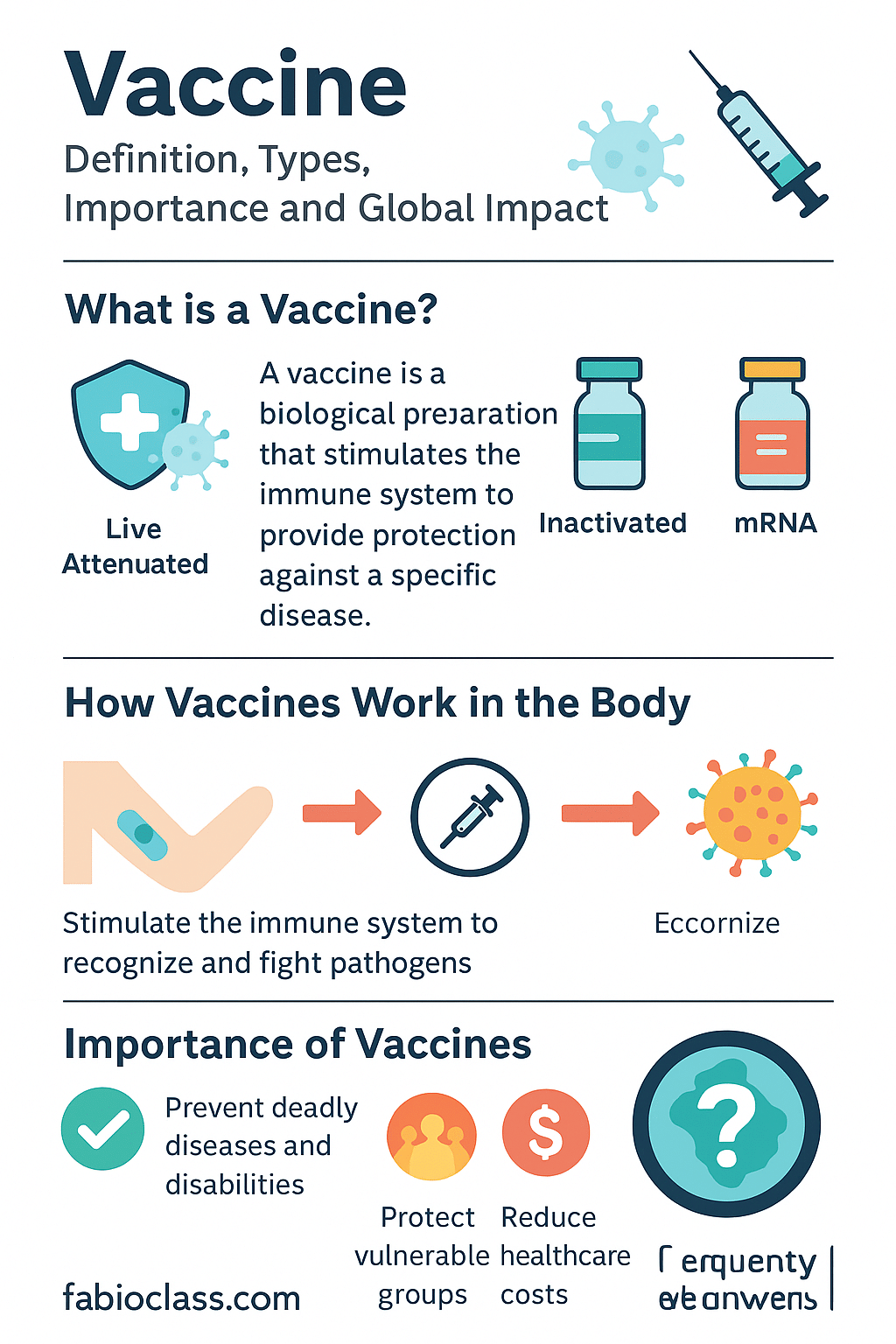
A vaccine is a biological substance designed to provide immunity against a specific disease. It contains a weakened or inactive part of a microorganism (such as a virus or bacterium), or a piece of it like proteins or genetic material. When introduced into the body, it stimulates the immune system to recognize and fight the pathogen if exposed in the future.
Unlike medicine, which treats disease after infection, a vaccine prevents it from happening in the first place. This makes it one of the most cost-effective and sustainable ways of promoting health.
History of Vaccines
The story of vaccines begins in the 18th century with Edward Jenner. In 1796, Jenner discovered that exposure to cowpox protected people from smallpox. He used material from cowpox sores to immunize a young boy, marking the birth of vaccination.
Later, Louis Pasteur advanced the science by developing vaccines for rabies and anthrax in the 19th century. Over the 20th century, new vaccines emerged, including for polio, measles, and tetanus. These developments reduced childhood deaths significantly.
In 1980, smallpox became the first human disease officially eradicated through vaccination. Today, vaccination programs aim to eradicate or control other diseases like polio and measles.
Types of Vaccines
There are different types of vaccines, each made using different scientific approaches:
1. Live Attenuated Vaccines
These contain weakened forms of the virus or bacteria that cannot cause severe illness. Examples include the measles, mumps, and rubella (MMR) vaccine and the oral polio vaccine.
2. Inactivated Vaccines
These contain killed pathogens. They cannot replicate but still trigger immunity. Examples are the hepatitis A vaccine and the inactivated polio vaccine.
3. Subunit, Recombinant, and Conjugate Vaccines
These use only parts of the pathogen (like proteins or sugars) to stimulate immunity. Examples include the hepatitis B vaccine and HPV vaccine.
4. mRNA Vaccines
A modern type of vaccine that delivers genetic instructions to cells to produce proteins that trigger an immune response. COVID-19 vaccines like Pfizer-BioNTech and Moderna are examples.
5. Toxoid Vaccines
These target toxins produced by bacteria rather than the bacteria themselves. Examples are diphtheria and tetanus vaccines.
6. Vector-Based Vaccines
These use another harmless virus as a carrier to deliver parts of the pathogen. Examples include the Johnson & Johnson COVID-19 vaccine.
How Vaccines Work in the Body
Vaccines train the immune system without causing the actual disease. When the vaccine enters the body, the immune system recognizes the foreign material as a threat. White blood cells produce antibodies and memory cells that remain in the body for years.
If the person is later exposed to the real pathogen, the immune system responds faster and stronger, preventing illness. This is why vaccines are considered a form of “immune memory.”
Importance of Vaccines
Vaccines are important for individuals, families, communities, and nations. They:
Prevent deadly diseases and disabilities
Protect vulnerable groups such as children and elderly
Reduce healthcare costs by preventing hospitalizations
Contribute to herd immunity, which protects unvaccinated people
Support global health security during outbreaks
Examples of Common Vaccines
Some widely used vaccines include:
Polio vaccine
Measles, mumps, and rubella (MMR) vaccine
Diphtheria, tetanus, and pertussis (DTaP) vaccine
Hepatitis A and B vaccines
Influenza vaccine
HPV vaccine
COVID-19 vaccines
How Vaccines Are Produced
Vaccine production involves several stages:
- Research and discovery
- Pre-clinical testing in labs and animals
- Clinical trials in humans (Phase I, II, and III)
- Regulatory approval
- Large-scale manufacturing
- Quality control and distribution
This process can take years, though COVID-19 vaccines showed that with global cooperation and funding, it can be done faster.
Vaccine Distribution and Access
Distributing vaccines worldwide is a huge challenge. High-income countries often have faster access, while low-income countries rely on organizations like WHO, GAVI, and UNICEF. Cold chain storage is also critical, especially for mRNA vaccines that require very low temperatures.
Challenges Facing Vaccination Programs
Vaccine hesitancy and misinformation
High production costs
Limited access in rural and poor communities
Cold chain requirements
Emergence of new virus variants
Modern Research and Innovation in Vaccines
Research today focuses on:
Developing universal flu vaccines
Using nanotechnology for delivery
Exploring DNA vaccines
Personalized cancer vaccines
Expanding mRNA vaccine use beyond COVID-19
Global Impact of Vaccines
Vaccines prevent 4–5 million deaths each year globally. They have eradicated smallpox and nearly eliminated polio. They also reduce economic loss from healthcare costs and productivity loss due to illness.
The Role of Vaccines in Epidemics and Pandemics
During pandemics, vaccines are critical. COVID-19 vaccines saved millions of lives. In Ebola outbreaks, vaccines also helped control spread. Vaccination reduces mortality and speeds recovery of normal life.
Economic Importance of Vaccination
Vaccines reduce medical costs, hospital stays, and productivity losses. For governments, every dollar spent on vaccination saves multiple dollars in healthcare and social costs.
Social Importance of Vaccination
Vaccination builds community trust, improves school attendance, and supports workforce stability. It also prevents social disruptions caused by epidemics.
The Future of Vaccines
The future of vaccines lies in technology. mRNA, DNA, and personalized vaccines will become more common. Scientists are working on vaccines for HIV, malaria, and even chronic diseases like cancer.
Conclusion
Vaccines remain one of humanity’s greatest weapons against disease. They not only protect individuals but strengthen entire societies. The history, present, and future of vaccines show their unmatched role in saving lives, preventing outbreaks, and supporting global health.
For related articles, see:
Immune system explained on fabioclass.com
Pathogen: definition and importance on fabioclass.com
Infectious diseases and prevention on fabioclass.com
Frequently Asked Questions (FAQs) About Vaccines
1. What is the definition of a vaccine?
A vaccine is a biological preparation that helps the body build immunity against a disease.
- Who developed the first vaccine?
Edward Jenner in 1796 developed the smallpox vaccine. - Why are vaccines important?
They prevent deadly diseases, save lives, and reduce healthcare costs. - How do vaccines work in the body?
They stimulate the immune system to create antibodies and memory cells. - What are the main types of vaccines?
Live attenuated, inactivated, subunit, mRNA, toxoid, and vector-based. - Are vaccines safe?
Yes, vaccines are tested for safety before approval. Side effects are usually mild. - What is herd immunity?
It occurs when enough people are vaccinated, reducing spread and protecting unvaccinated individuals. - Can vaccines cause the disease they prevent?
No, most vaccines cannot cause the disease. Live vaccines use weakened forms that are safe for healthy individuals. - What are common side effects of vaccines?
Mild fever, soreness at injection site, and fatigue. - Why do children need many vaccines?
Children are more vulnerable to infections, and vaccines protect them early. - Can vaccines protect against cancer?
Yes, HPV and hepatitis B vaccines prevent cancers caused by those viruses. - What is the difference between a vaccine and a medicine?
Vaccines prevent disease, while medicine treats it after infection. - Do vaccines provide lifelong immunity?
Some do, like measles, while others require boosters, like tetanus. - How are vaccines stored?
They are stored in cold chains to maintain potency. - Why are some people against vaccines?
Due to misinformation, fear, or religious and cultural beliefs. - What is an mRNA vaccine?
It delivers genetic instructions to cells to produce proteins that trigger immunity. - Are vaccines effective against new virus variants?
Most remain effective, though boosters may be needed. - What diseases have been eradicated by vaccines?
Smallpox is eradicated; polio is close to eradication. - How are vaccines funded in poor countries?
Through international programs like GAVI and WHO support. - What is the future of vaccines?
Personalized vaccines, universal flu vaccines, and advanced genetic approaches.