
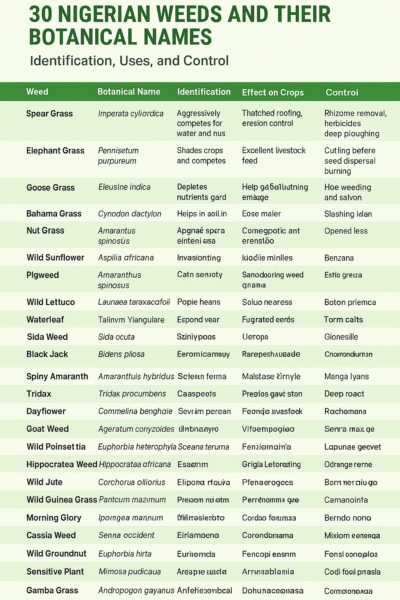
30 Nigerian Weeds and Their Botanical Names: Identification, Uses, and Control
Learn about 30 Nigerian weeds and their botanical names, including their identification, uses, effects on crops, and control methods. This detailed guide covers common weeds in Nigeria for students, farmers, and researchers.
Introduction
Weeds are unwanted plants that grow where they are not needed. In Nigeria, they are a major challenge to farmers because they compete with crops for sunlight, nutrients, and water, reducing overall yield. However, many weeds also have economic, medicinal, and ecological uses, making it important to study them.
This article provides a detailed list of 30 Nigerian weeds and their botanical names, along with their characteristics, uses in Nigeria, harmful effects on crops, and methods of weed control. Whether you are a farmer, student, or researcher, understanding weeds and their botanical names will help you manage your farmland more effectively.
Frequently Asked Questions (FAQ)
Q1. What are the most common weeds in Nigeria?
The most common weeds include spear grass (Imperata cylindrica), elephant grass (Pennisetum purpureum), nut grass (Cyperus rotundus), black jack (Bidens pilosa), and Siam weed (Chromolaena odorata).
Q2. Why is it important to know the botanical names of weeds?
Botanical names provide a universal language for identification, helping avoid confusion from local names and enabling accurate weed control and research.
Q3. How do weeds affect agriculture in Nigeria?
Weeds compete with crops for nutrients, water, sunlight, and space. They reduce yields, harbor pests, and increase farm management costs.
Q4. Are there useful weeds in Nigeria?
Yes. Some weeds, such as waterleaf (Talinum triangulare) and pigweed (Amaranthus spinosus), are edible or used in traditional medicine. Others help with soil improvement or serve as livestock fodder.
Q5. What are broadleaf weeds and grass weeds?
Broadleaf weeds, like black jack (Bidens pilosa), have wide leaves and belong to various plant families. Grass weeds, such as spear grass (Imperata cylindrica), have narrow leaves and belong to the Poaceae family.
Q6. Which Nigerian weed is considered most invasive?
Siam weed (Chromolaena odorata) is highly invasive, covering farmlands quickly and suppressing crop growth.
Q7. How can farmers control weeds effectively?
Control methods include manual weeding, hoeing, mulching, herbicide application, crop rotation, and integrated weed management.
Q8. Can weeds ever be completely eliminated?
No. Weeds cannot be completely eliminated, but their impact can be managed through regular and strategic control measures.
Q9. Are Nigerian weeds similar to weeds in other African countries?
Yes. Many weeds like Bidens pilosa, Chromolaena odorata, and Imperata cylindrica are common across West Africa, though their prevalence varies by region.
Q10. Do all weeds harm crops?
Not all weeds are harmful. While many reduce crop yields, some provide ecological or economic benefits, such as soil cover, food, or medicinal uses.
Q11. How do weeds spread in farms?
Weeds spread through seeds, rhizomes, stolons, or vegetative parts. Human activity, wind, water, and animals can also facilitate their dispersal.
Q12. Which weeds in Nigeria are used as vegetables?
Waterleaf (Talinum triangulare), wild lettuce (Launaea taraxacifolia), and jute mallow (Corchorus olitorius) are commonly consumed as leafy vegetables.
Q13. Are weeds used in traditional medicine?
Yes. Several weeds, including Aspilia africana, Ageratum conyzoides, and Bidens pilosa, are used to treat various ailments in traditional Nigerian medicine.
Q14. Do weeds affect soil fertility?
Some weeds deplete soil nutrients by competing with crops, while others, like legumes, may enhance soil fertility through nitrogen fixation.
Q15. How can knowledge of weeds improve farm productivity?
Understanding weeds and their botanical names helps farmers identify harmful species, implement effective control, and even utilize beneficial weeds for food, medicine, or soil improvement.
1. Spear Grass (Imperata cylindrica)
Identification: Tall perennial grass with sharp rhizomes.
Effect on crops: Aggressively competes for water and nutrients.
Uses: Thatched roofing, erosion control.
Control: Rhizome removal, herbicides, deep ploughing.
2. Elephant Grass (Pennisetum purpureum)
Identification: Tall, fast-growing grass, sometimes cultivated for fodder.
Effect on crops: Shades crops and competes for nutrients.
Uses: Excellent livestock feed.
Control: Cutting before seed dispersal, burning, or herbicide.
3. Goose Grass (Eleusine indica)
Identification: Low-growing grass with finger-like flower heads.
Effect on crops: Depletes nutrients in gardens and farms.
Uses: Helps in soil binding.
Control: Hoe weeding and selective herbicides.
4. Bahama Grass (Cynodon dactylon)
Identification: A creeping perennial with stolons and rhizomes.
Effect on crops: Invades crop fields quickly.
Uses: Lawns, erosion control.
Control: Repeated hoeing, deep tillage.
5. Nut Grass (Cyperus rotundus)
Identification: A sedge with underground nut-like tubers.
Effect on crops: Extremely difficult to eradicate; reduces yield.
Uses: Traditional medicine for stomach ailments.
Control: Tubers removal, chemical herbicides.
6. Wild Sunflower (Aspilia africana)
Identification: Tall perennial with yellow flowers.
Effect on crops: Competes in cassava and maize farms.
Uses: Used to stop bleeding in traditional medicine.
Control: Uprooting and slashing.
7. Pigweed (Amaranthus spinosus)
Identification: Broadleaf annual with spiny stems.
Effect on crops: Common in vegetable farms.
Uses: Edible leafy vegetable, medicinal.
Control: Timely hoe weeding and mulching.
8. Wild Lettuce (Launaea taraxacifolia)
Identification: Creeping broadleaf weed.
Effect on crops: Competes in vegetable beds.
Uses: Popular leafy vegetable.
Control: Manual uprooting.
9. Waterleaf (Talinum triangulare)
Identification: Succulent leafy plant.
Effect on crops: Spreads quickly on farmlands.
Uses: Edible vegetable rich in vitamins.
Control: Hand weeding at early stages.
10. Sida Weed (Sida acuta)
Identification: Woody shrub with yellow flowers.
Effect on crops: Invasive on farmland edges.
Uses: Used in malaria treatment traditionally.
Control: Slashing before flowering.
11. Black Jack (Bidens pilosa)
Identification: Tall weed with sticky seeds.
Effect on crops: Spreads rapidly and reduces yields.
Uses: Used in herbal medicine.
Control: Hand pulling and herbicides.
12. Spiny Amaranth (Amaranthus hybridus)
Identification: Erect annual with spiny stems.
Effect on crops: Invades maize and cassava farms.
Uses: Edible vegetable.
Control: Hoeing and mulching.
13. Tridax (Tridax procumbens)
Identification: Creeping weed with small yellow flowers.
Effect on crops: Occupies farmland quickly.
Uses: Herbal wound treatment.
Control: Regular weeding.
14. Dayflower (Commelina benghalensis)
Identification: Succulent creeping plant with blue flowers.
Effect on crops: Competes in gardens.
Uses: Used as fodder.
Control: Uprooting.
15. Goat Weed (Ageratum conyzoides)
Identification: Hairy plant with purple-blue flowers.
Effect on crops: Suppresses crop germination chemically.
Uses: Used in herbal medicine.
Control: Hoeing and herbicides.
16. Wild Poinsettia (Euphorbia heterophylla)
Identification: Broadleaf weed with milky latex.
Effect on crops: Invades maize and soybean farms.
Control: Timely hoeing.
17. Hippocratea Weed (Hippocratea africana)
Identification: Climbing woody weed.
Effect on crops: Smothers young crops.
Control: Cutting and burning.
18. Wild Jute (Corchorus olitorius)
Identification: Erect leafy weed.
Effect on crops: Common in cassava farms.
Uses: Popular soup vegetable.
Control: Hand weeding.
19. Wild Guinea Grass (Panicum maximum)
Identification: Tall perennial grass.
Effect on crops: Reduces yields by shading.
Uses: Livestock fodder.
Control: Slashing and herbicides.
20. Morning Glory (Ipomoea triloba)
Identification: Creeping twiner with purple flowers.
Effect on crops: Smothers crops.
Control: Uprooting and burning.
21. Cassia Weed (Senna occidentalis)
Identification: Broadleaf shrubby weed.
Effect on crops: Common in maize farms.
Uses: Medicinal.
Control: Uprooting before flowering.
22. Mexican Fire Plant (Euphorbia hirta)
Identification: Small reddish herb.
Effect on crops: Competes in vegetable plots.
Uses: Herbal treatment for asthma.
Control: Hoeing and mulching.
23. Broom Weed (Sida rhombifolia)
Identification: Shrubby weed.
Effect on crops: Invades neglected lands.
Uses: Used to make brooms.
Control: Slashing.
24. Wild Groundnut (Calopogonium mucunoides)
Identification: Creeping legume.
Effect on crops: Spreads quickly in cassava fields.
Uses: Fodder, cover crop.
Control: Manual removal.
25. Sensitive Plant (Mimosa pudica)
Identification: Creeping plant with touch-sensitive leaves.
Effect on crops: Spreads in neglected farms.
Uses: Traditional medicine.
Control: Uprooting.
26. Gamba Grass (Andropogon gayanus)
Identification: Tall perennial grass.
Effect on crops: Reduces soil nutrients.
Uses: Livestock feed.
Control: Slashing and burning.
27. Wild Pepper (Solanum torvum)
Identification: Shrub with small round fruits.
Effect on crops: Shading effect on crops.
Uses: Used as spice and medicine.
Control: Cutting before fruiting.
28. Siam Weed (Chromolaena odorata)
Identification: Invasive perennial with soft hairy leaves.
Effect on crops: Covers farmlands, preventing crop growth.
Uses: Green manure.
Control: Burning, herbicide.
29. Wild Sorghum (Sorghum arundinaceum)
Identification: Tall cereal-type weed.
Effect on crops: Competes heavily in millet farms.
Control: Hoeing before maturity.
30. Crowfoot Grass (Dactyloctenium aegyptium)
Identification: Low-growing grass with claw-shaped flower heads.
Effect on crops: Competes with cereals.
Control: Manual weeding.
Frequently Asked Questions (FAQ)
What are the most common weeds in Nigeria?
Examples include spear grass (Imperata cylindrica), nut grass (Cyperus rotundus), and Siam weed (Chromolaena odorata).
Do weeds in Nigeria have economic value?
Yes. Some like waterleaf (Talinum triangulare), pigweed (Amaranthus spinosus), and jute mallow (Corchorus olitorius) are used as vegetables, while others like Aspilia africana and Ageratum conyzoides have medicinal uses.
How do farmers control weeds in Nigeria?
Methods include manual weeding, hoeing, burning, crop rotation, herbicides, and mulching.
Why is it important to know the botanical names of Nigerian weeds?
Botanical names help in proper identification and research, avoiding confusion since common names vary across regions.
Summary
This guide has listed 30 Nigerian weeds and their botanical names, highlighting their identification, uses, harmful effects, and control. Knowing these weeds is essential for agriculture in Nigeria, as it helps farmers manage crops better and improve yields. While weeds are often destructive, some also provide food, medicine, or ecological benefits. Effective weed management requires both traditional methods like hoeing and modern techniques such as herbicide use.
Originally posted 2025-08-26 15:12:35.