
Abiogenesis: How Life Originated from Non-Living Matter
Introduction
How did life begin on Earth? This question has intrigued scientists, philosophers, and thinkers for centuries. The leading scientific explanation is abiogenesis—the natural process by which life arises from non-living chemical substances. Unlike biogenesis, which describes life emerging from existing organisms, abiogenesis explores the earliest transition from inorganic compounds to self-replicating biological systems.
In this comprehensive guide, we’ll explore the stages of abiogenesis, the most prominent hypotheses, experimental evidence, and its implications for science and astrobiology. We’ll also answer the most frequently asked questions to clarify common misconceptions and deepen your understanding.
What Is Abiogenesis?
Abiogenesis refers to the origin of life from non-living matter, typically under early Earth conditions. This process is believed to have occurred over 3.5 billion years ago, long before the emergence of complex organisms. It involves a gradual transformation of simple molecules into increasingly complex structures capable of replication and metabolism. check out this post on cell theory and hypothesis
- “how did life originate from non-living matter”
- “scientific explanation for origin of life on Earth”
- “natural process of abiogenesis in early Earth conditions”
- “difference between abiogenesis and spontaneous generation”
- “RNA world hypothesis and origin of life”
Historical Context
The concept of abiogenesis has evolved significantly over time. Ancient beliefs in spontaneous generation—the idea that life could emerge from decaying matter—were debunked by Louis Pasteur in the 19th century. Modern abiogenesis theory was shaped by:
- Alexander Oparin and J.B.S. Haldane, who proposed the “primordial soup” model in the 1920s.
- The Miller–Urey experiment (1953), which demonstrated that amino acids could form under simulated early Earth conditions.
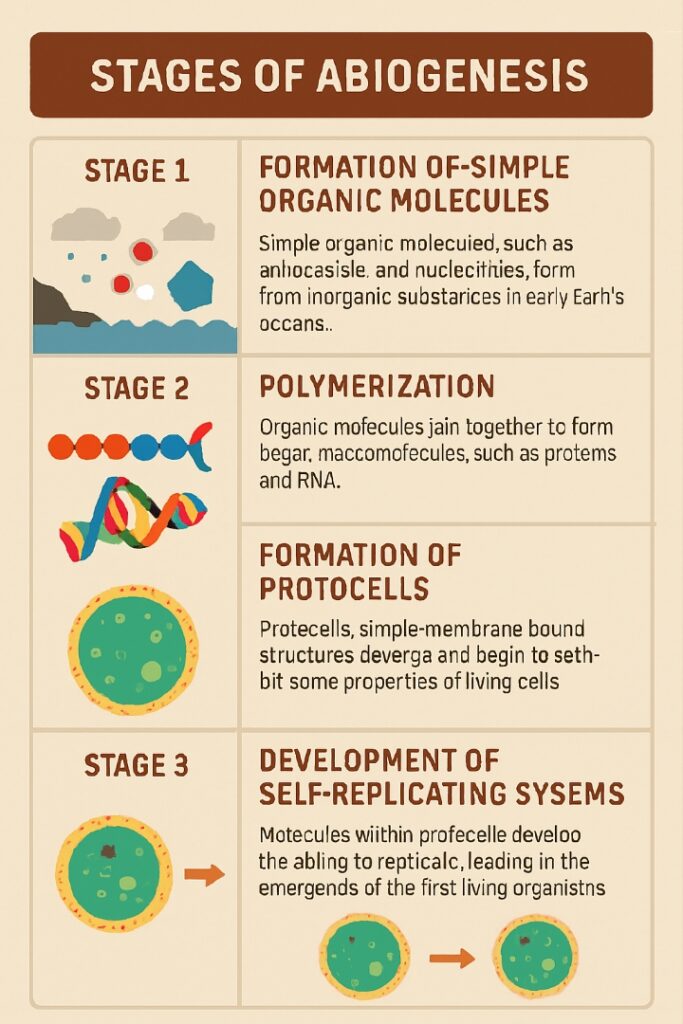
Key Stages in Abiogenesis
- Formation of Organic Molecules
Early Earth’s atmosphere likely contained methane, ammonia, hydrogen, and water vapor. Under the influence of lightning or ultraviolet radiation, these gases reacted to form simple organic compounds such as amino acids and nucleotides.
- Polymerization of Monomers
Organic monomers linked together to form polymers like proteins and RNA. This step was essential for the development of biochemical functions.
- Self-Replication and Catalysis
RNA molecules are believed to have been the first self-replicating systems. The RNA world hypothesis suggests that RNA could both store genetic information and catalyze chemical reactions. here is a post on genetics and gene
- Compartmentalization
Lipids formed membranes around these molecules, creating protocells—primitive cell-like structures capable of maintaining internal environments and facilitating metabolic reactions.
- Evolution of Cellular Life
Through natural selection, protocells evolved into more complex organisms. DNA eventually replaced RNA as the primary genetic material, and proteins took over catalytic functions.
Leading Hypotheses in Abiogenesis Research
RNA World Hypothesis
This widely supported theory suggests that RNA was the first genetic material due to its dual role in replication and catalysis. Laboratory experiments have shown that RNA can evolve under selective pressure.
Metabolism-First Hypothesis
This hypothesis proposes that metabolic networks formed before genetic material. These networks may have originated on mineral surfaces, such as iron-sulfur compounds.
Hydrothermal Vent Theory
Suggests life began in deep-sea hydrothermal vents, where mineral-rich water and heat created ideal conditions for chemical evolution.
Panspermia (Alternative Theory)
Posits that life’s building blocks arrived from space via meteorites or comets. While not a form of abiogenesis, it’s often discussed in origin-of-life debates.
Experimental Evidence Supporting Abiogenesis
- Miller–Urey Experiment: Produced amino acids from inorganic gases using electric sparks.
- RNA Replication Studies: Demonstrated RNA’s ability to replicate and evolve in lab conditions.
- Hydrothermal Vent Simulations: Showed formation of organic molecules in vent-like environments.
- Meteorite Analysis: Revealed amino acids and nucleobases in space rocks, supporting the idea that organic compounds can form in extraterrestrial environments.
Implications for Astrobiology
Abiogenesis is central to the search for life beyond Earth. If life can emerge from non-living matter under specific conditions, then planets or moons with similar environments—such as Mars, Europa, or Enceladus—could potentially support life. Understanding abiogenesis helps scientists identify biosignatures and design missions to detect life elsewhere in the universe.
Frequently Asked Questions (FAQs)
- What is the difference between abiogenesis and biogenesis?
Abiogenesis refers to life arising from non-living matter, while biogenesis describes life originating from existing organisms. - Has abiogenesis been proven?
Abiogenesis has not been directly observed but is supported by experimental and theoretical evidence. It remains the most scientifically accepted explanation for life’s origin. - What is the RNA world hypothesis?
It proposes that RNA was the first self-replicating molecule, capable of storing genetic information and catalyzing reactions. - Can abiogenesis occur today?
Unlikely. Modern Earth’s oxygen-rich atmosphere and microbial competition prevent the conditions necessary for abiogenesis. - What did the Miller–Urey experiment demonstrate?
It showed that amino acids could form from inorganic compounds under early Earth-like conditions. - Is abiogenesis the same as spontaneous generation?
No. Spontaneous generation suggested complex life could arise suddenly from decaying matter, which has been disproven. - What role do hydrothermal vents play in abiogenesis?
They may have provided heat, minerals, and chemical gradients ideal for the formation of organic molecules. - Could life have come from space?
Panspermia suggests this possibility, but it doesn’t explain how life originally formed—only how it may have traveled. - What are protocells?
Protocells are simple, membrane-bound structures that may have been precursors to living cells. - Why is abiogenesis important to science?
It helps explain the origin of life, informs evolutionary biology, and guides the search for extraterrestrial life. - What are amino acids and why are they important?
Amino acids are organic compounds that form proteins, essential for biological functions. - How do scientists simulate early Earth conditions?
They use controlled lab environments with gases, heat, and energy sources like UV light or electricity. - What is the role of lipids in abiogenesis?
Lipids can form membranes, creating compartments that protect and organize biochemical reactions. - Are there competing theories to abiogenesis?
Yes, including panspermia and intelligent design, though abiogenesis remains the most scientifically supported. - What is LUCA (Last Universal Common Ancestor)?
LUCA represents the most recent common ancestor of all current life forms and helps trace evolutionary pathways.
Conclusion
Abiogenesis offers a compelling scientific framework for understanding how life could emerge from non-living matter. While the exact sequence of events remains under investigation, ongoing research continues to illuminate the chemical and environmental conditions that may have sparked the first living systems. For educators, students, and science enthusiasts, abiogenesis is not just a theory—it’s a gateway to exploring life’s deepest origins and its potential beyond Earth.
Originally posted 2025-08-19 15:53:18.