
BIOLUMINESCENCE: NATURE’S LIVING LIGHT
Introduction
Bioluminescence is the natural ability of living organisms to produce light through chemical reactions within their bodies. This captivating phenomenon is seen in deep-sea creatures, some fungi, microorganisms, and even a few terrestrial animals. From the flickering glow of fireflies to the mysterious blue shimmer in ocean waves, bioluminescence is both a survival tool and a breathtaking spectacle.
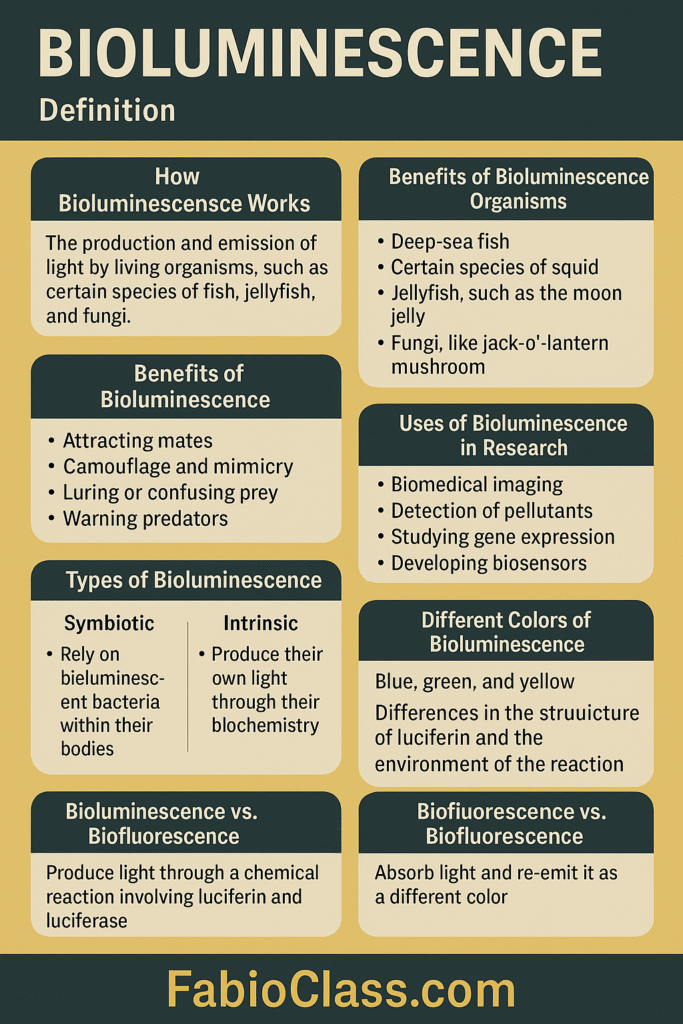
Definition of Bioluminescence
Bioluminescence is the emission of light by a living organism, resulting from a chemical reaction between a light-emitting molecule (luciferin) and an enzyme (luciferase). Unlike fluorescence, which requires an external light source, bioluminescence is self-generated.
History of Bioluminescence Studies
Humans have marveled at glowing organisms for centuries. Ancient Greek and Roman writings describe glowing fish and fungi. In the 17th century, naturalists began documenting the mechanisms behind the glow. By the 20th century, scientists had identified luciferin and luciferase, opening the door for genetic engineering applications.
How Bioluminescence Works
The chemical reaction involves:
- Luciferin – the molecule that emits light when oxidized.
- Luciferase – the enzyme that speeds up the reaction.
- Oxygen – required for oxidation.
- ATP (in some cases) – provides energy for the reaction.
The general reaction:
Luciferin + Oxygen + Luciferase → Oxyluciferin + Light
The color of the light depends on the type of luciferin, pH, and surrounding environment, ranging from blue-green in deep-sea animals to yellow in fireflies.
Types of Bioluminescence
- Marine Bioluminescence – found in jellyfish, deep-sea fish, plankton, and squid.
- Terrestrial Bioluminescence – seen in fireflies, some beetles, and certain fungi.
- Symbiotic Bioluminescence – organisms host bioluminescent bacteria in specialized organs (e.g., flashlight fish).
Functions of Bioluminescence
Attracting Prey – anglerfish use light lures to catch smaller fish.
Camouflage – counter-illumination hides organisms from predators below.
Communication – fireflies flash to attract mates.
Defense – squid eject glowing ink to confuse predators.
Illumination – some deep-sea species use light to navigate dark waters.
Examples of Bioluminescent Organisms
Fireflies (Photinus species) – land insects with mating flash patterns.
Dinoflagellates – microscopic plankton responsible for glowing ocean waves.
Lanternfish – deep-sea fish with light organs for communication.
Fungi (e.g., Armillaria mellea) – glow to attract insects for spore dispersal.
Anglerfish – predator with a glowing lure.
Bioluminescence vs. Fluorescence
Bioluminescence: Light is produced by a chemical reaction within the organism.
Fluorescence: Requires absorption of external light and re-emission at a different wavelength.
Applications of Bioluminescence in Science and Technology
- Medical Research – tracking cell and gene activity using bioluminescent markers.
- Environmental Monitoring – detecting pollution using engineered glowing bacteria.
- Forensic Science – locating biological traces in crime scenes.
- Marine Exploration – studying deep-sea ecosystems.
- Biotechnology – creating bioluminescent plants for sustainable lighting.
Importance of Bioluminescence
Bioluminescence is vital for ecological interactions, predator-prey balance, and reproduction in many species. It also provides scientists with natural tools for bioengineering, disease tracking, and environmental protection.
Challenges in Studying Bioluminescence
Many bioluminescent species live in deep oceans, making them difficult to observe.
Some produce light only under specific conditions.
The chemistry varies greatly between species, complicating research.
Future Prospects of Bioluminescence
Bioluminescent streetlights – using genetically modified plants.
Advanced disease diagnostics – improved imaging for cancer research.
Underwater navigation – developing bio-based lighting for deep-sea expeditions.
Summary
Bioluminescence is one of nature’s most mesmerizing adaptations, combining beauty with biological purpose. Its applications extend beyond the natural world, influencing medicine, technology, and environmental science.
10 FAQs About Bioluminescence
What causes bioluminescence?
It’s caused by a chemical reaction between luciferin and luciferase in the presence of oxygen.
Where is bioluminescence most common?
It’s most common in marine habitats environments, especially in the deep sea.
Is bioluminescence the same as fluorescence?
No, bioluminescence is self-generated light, while fluorescence needs external light.
Can humans be bioluminescent?
No, humans cannot naturally produce bioluminescence.
Why do fireflies glow?
They use light signals to attract mates.
What color is most common in marine bioluminescence?
Blue-green light, as it travels best through water.
Are all glowing organisms bioluminescent?
No, some are fluorescent or phosphorescent instead.
How do scientists use bioluminescence?
For disease research, environmental monitoring, and genetic studies.
Is bioluminescence dangerous?
Generally no, but certain glowing algae blooms (red tides) can release toxins.
Will we see bioluminescent plants in the future?
Yes, researchers are developing genetically modified glowing plants for lighting.
Originally posted 2025-08-10 11:44:22.