
roles of government in agricultural development. Government plays an important role in the development of agriculture in Nigeria.
This role of government in agricultural development has helped to solve the numerous problems which resulted in the poor development of agriculture which is a factor role of government in agricultural development

The roles of government in agricultural development include
Provision of credit facilities: The government, one of the roles of government in agricultural development through its various agencies, has helped in the provision of credit facilities to farmers in the form of loans, credit and subsidies.
Agencies like Nigeria Agricultural and Co-operative Nigeria (N.A.C.B), Agricultural Credit Guarantee Scheme (A.C.G.S), etc were established to give loans to farmers.
Establishment of agriculture programmes: The government decided to establish agriculture programmes with the aim of boosting greater production of crops and livestock and many other roles of the government
Example of such programmes includes:
River Basin Development Authority (RBDA)
Green Revolution (GR)
Operation Feed the Nation (OFN)
Agricultural Development Projects(ADP)
as roles of government in agricultural development
Provision of farm input: Farm input like chemicals, farm tools and implements and fertilizers, improved seeds are not only provided by the government in sufficient quantities but are subsided to enable peasant farmers to buy and use them. see more on subsistence agriculture here
Provision of storage and processing facilities: In order to prevent food wastage and provide food in periods of scarcity, the government decided to provide storage and processing facilities in all parts of the country roles of government in agricultural development
Provision of basic amenities: In order to discourage the migration of able-bodied men and youths from rural to urban areas,
the government has endeavoured to provide basic amenities such as electricity, pipe-borne water and health care services in rural areas roles of government in agricultural development
Provision of an efficient transportation network: The government, through its agencies like the Directorate for Food, Roads and Rural Infrastructure (DFRRI),
has helped in the construction of feeder roads in rural areas to east transportation of produce from the farm or rural areas to the urban centre
Provision of Pest and Diseases Control services: For farmers to produce foodstuffs in large quantities, one of the roles of government in agricultural development is that the government makes provision for drugs,
chemicals and vaccines which are used for pest and disease control=== roles of government in agriculture
Provision of extension services: Extension services enable new ideas and innovations to get the rural farmers.
Provision of agricultural education: In view of the fact that the majority of Nigerian farmers are illiterate, the government decided to provide adult education e.g. nomadic education (for cattle rearers),
to enable them to read and write, to apply modern systems of farming and also to promote easy acceptance of new techniques and innovation in agriculture— roles of government in agriculture
Provision of research findings: In order to improve the local varieties or breeds of crops and animals respectively,
the government also set up numerous research institutes for local crops and animals with a view to increasing productivity.
what happens government does not participate in agricultural development?
What Happens When Government Fails to Participate in Agricultural Development?
Agriculture remains the backbone of many economies, especially in developing nations. However, when the government fails to actively support and participate in agricultural development, the consequences can be severe and far-reaching. Here’s a breakdown of what happens when the government is absent in this critical sector:
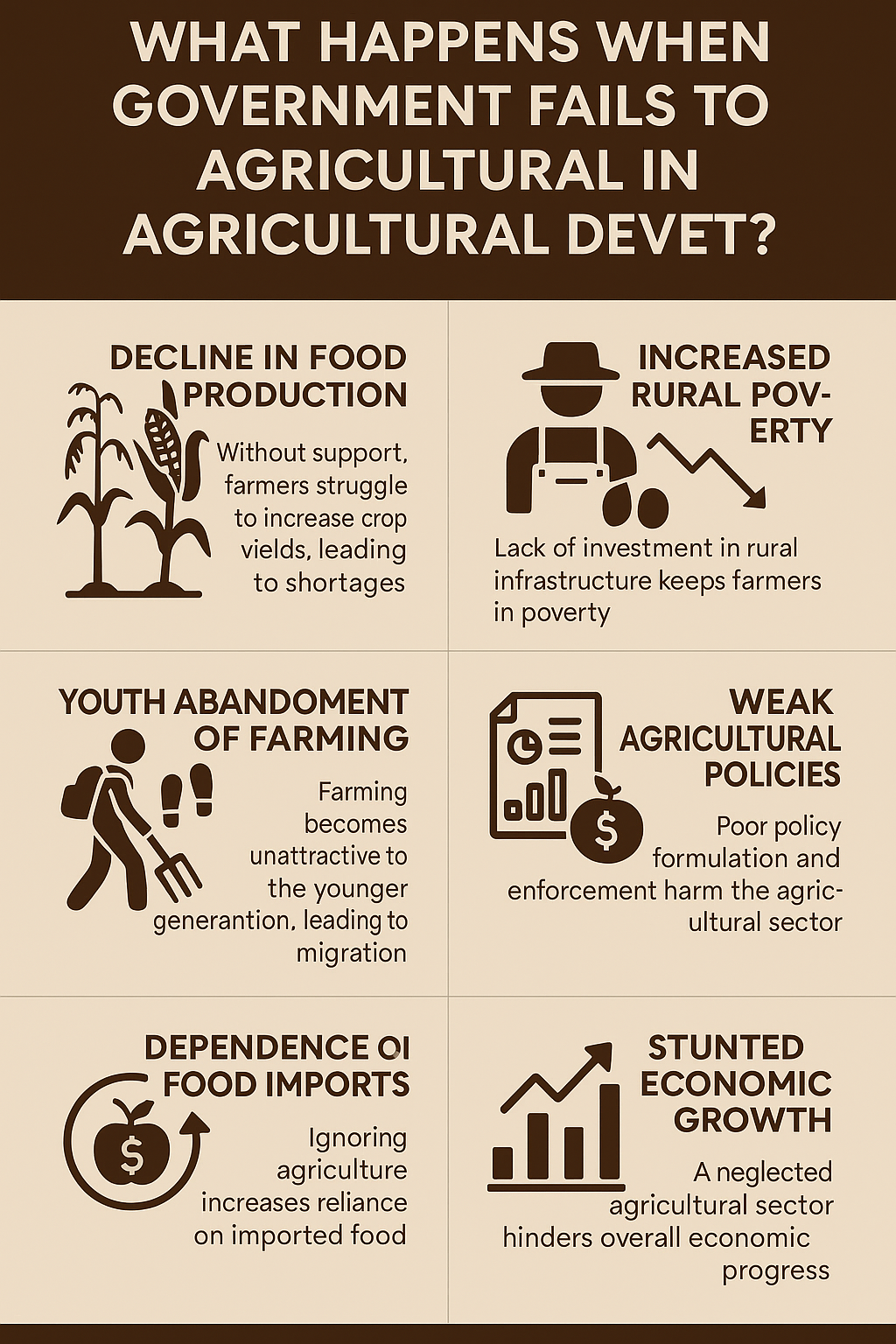
- Decline in Food Production
Without government support in the form of subsidies, improved seedlings, irrigation systems, and research funding, farmers are left to struggle on their own. This often leads to low productivity, poor harvests, and eventually food shortages that can drive up prices and increase hunger levels.
- Increased Rural Poverty
Agriculture is a primary source of income for many rural communities. When the government fails to invest in infrastructure like rural roads, power supply, and storage facilities, it limits farmers’ access to markets. This discourages production and leaves many stuck in poverty.
- Youth Abandonment of Farming
Without government-backed agricultural initiatives, farming becomes unattractive to the younger generation. They migrate to urban centers in search of white-collar jobs, leaving the agricultural sector in the hands of the aging population. This weakens long-term food security.
- Weak Agricultural Policies
Government involvement is key in formulating and enforcing policies that protect farmers, promote exports, and regulate food safety. In its absence, the sector becomes disorganized, vulnerable to exploitation, and unable to meet international standards.
- Dependence on Food Imports
Countries that neglect their agricultural sectors often become overly dependent on food imports. This drains foreign reserves, weakens national sovereignty, and exposes the country to global price shocks.
- Stunted Economic Growth
Agriculture contributes significantly to GDP and employment in many countries. When the sector is ignored, economic growth becomes unbalanced. Industrial development suffers too, since many industries rely on agricultural raw materials.
Final Thoughts on agricultural development abd government participation
Government participation in agriculture is not just about providing funds — it involves creating policies, infrastructure, education, and a support system that empowers farmers. For any nation to grow sustainably, its leaders must prioritize agriculture as a key pillar of development.
Did you find this post helpful? Let us know in the comments below and share with others who care about agricultural transformatio
economic tools for nation building
159. TAPE WORM
160. ROUND WORM OF PIGS
161. LIVER FLUKE
Originally posted 2025-07-02 16:34:56.