
A Complete Guide to Poultry Management Systems
Introduction:
Poultry farming plays a major role in food production and agricultural income around the world. One of the most important choices a poultry farmer must make is selecting the right poultry management system. This post covers the main types of systems, their advantages and disadvantages, and which ones are suitable for small or large-scale farming operations.
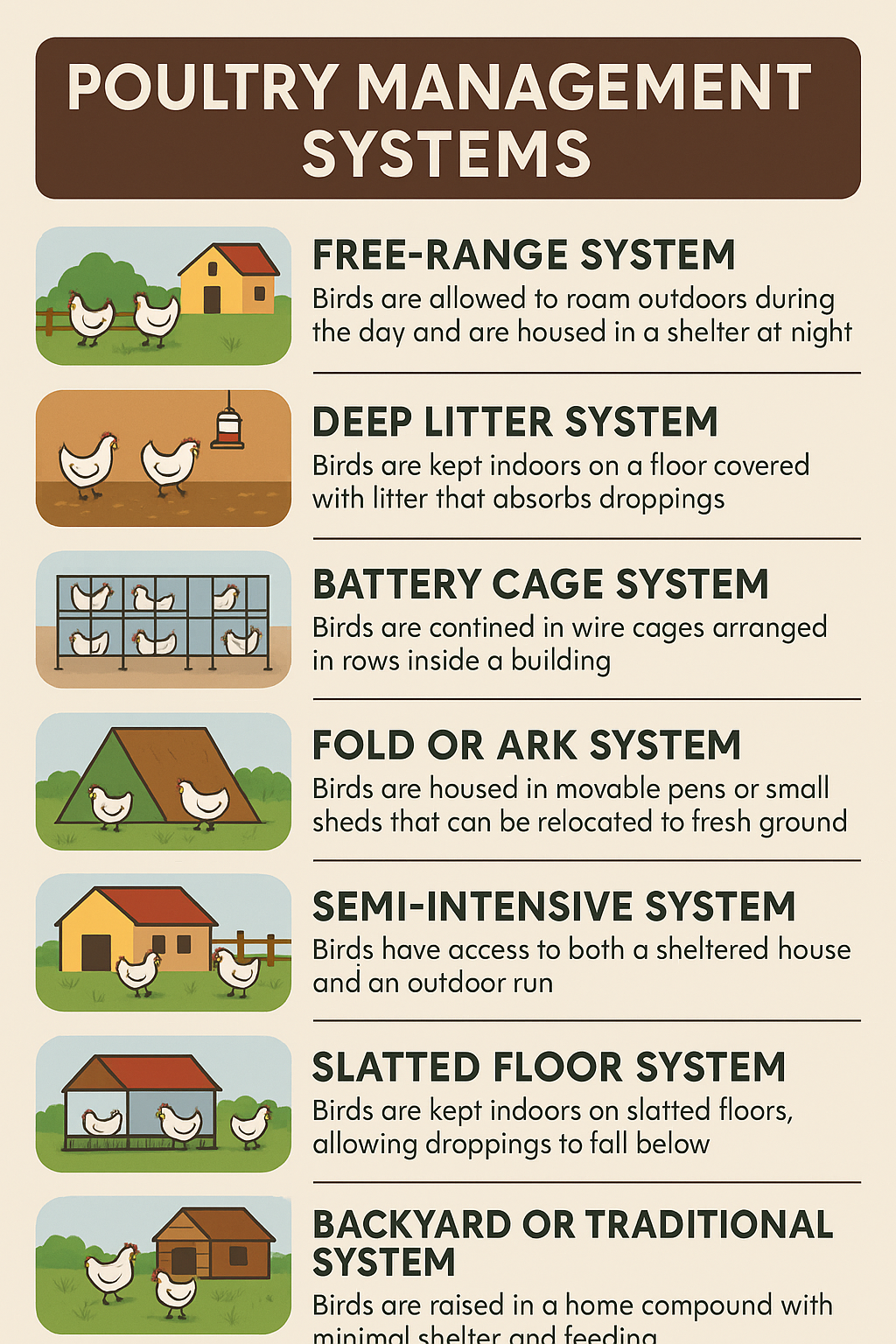
Types of poultry management systems
- Free-Range poultry management System
Description:
Birds are allowed to roam freely during the day and are housed in a shelter at night.
Key Features:
Birds forage for natural food.
Feed is supplemented.
Fencing may be used for security.
Pros:
Low feeding cost.
Birds behave naturally.
Can be labeled as organic.
Cons:
Risk of predators.
Exposure to diseases from the ground. Read more here
Requires more land space.
Climate Suitability:
Best in moderate or dry weather conditions.
- Deep Litter System
Description:
Birds are housed in an enclosed space with a floor covered by sawdust or wood shavings.
Key Features:
Droppings are absorbed by the litter.
Litter is stirred or replaced regularly.
Pros:
Clean and dry environment.
Protects birds from predators.
Suitable for both broilers and layers.
Cons:
Needs maintenance and proper ventilation.
Ammonia buildup can cause diseases.
Climate Suitability:
Can be used in any climate with proper housing.
- Battery Cage System
Description:
Birds are kept in wire cages arranged in rows and tiers.
Key Features:
Each cage has its own feed and water supply.
Eggs are collected easily through the slanted cage floor.
Pros:
High productivity.
Easy to manage and clean.
Saves space.
Cons:
High setup cost.
Restricted movement causes stress.
Public concern over animal welfare.
Climate Suitability:
Requires temperature control in hot climates.
- Fold or Ark System
Description:
Birds are placed in movable enclosures that are regularly moved to fresh ground.
Key Features:
Birds have access to grass and insects.
The structure is moved periodically.
Pros:
Reduces disease buildup.
Birds enjoy fresh pasture.
Cons:
Not ideal for large flocks.
Requires regular labor.
Climate Suitability:
Suitable for moderate climates and dry seasons.
- Semi-Intensive System
Description:
Birds are confined in a house but are allowed to roam in a fenced outdoor space during the day.
Key Features:
Combines indoor and outdoor benefits.
Reduces feeding cost.
Pros:
Balanced health and productivity.
Moderate cost.
Cons:
Needs land and fencing.
Requires management of both housing and pasture.
Climate Suitability:
Good for areas with mixed weather patterns.
- Slatted Floor System
Description:
Birds are raised on slatted floors that allow droppings to fall below into a collection area.
Key Features:
Reduces contact between birds and droppings.
Often used in breeder farms.
Pros:
Clean environment.
Reduces foot and disease problems.
Cons:
Expensive setup.
Birds may injure themselves on slats.
Climate Suitability:
Best in wet or humid areas.
- Backyard or Traditional System
Description:
This is the most basic system, where birds roam freely around homes or farms with little housing or feeding.
Key Features:
No structured feeding or healthcare.
Mostly used in rural areas.
Pros:
Very cheap to manage.
Low maintenance.
Cons:
Low productivity.
High mortality rates.
Vulnerable to disease and predators.
Climate Suitability:
Can be used in most rural environments, especially with local breeds.
Comparison Table
System Cost Productivity Labor Needs Welfare Climate Fit
Free-Range Medium Medium High High Dry/Moderate
Deep Litter Medium High Medium Good Any
Battery Cage High Very High Low Low Controlled Only
Fold System Medium Medium High High Dry/Moderate
Semi-Intensive Medium High Medium Good Mixed Climate
Slatted Floor High High Low Moderate Humid/Rainy
Backyard/Traditional Low Low Low Medium Rural Areas
Recommendation Summary:on poultry management systems
Small-scale farmers (under 100 birds): Use Deep Litter or Semi-Intensive systems.
Medium to large-scale (over 500 birds): Battery Cage or Slatted Floor systems are better.
Organic or low-input farms: Free-range, Fold, or Backyard systems work well.
Conclusion:
There is no one-size-fits-all poultry system. Your choice should depend on your goals, climate, budget, and available space. With the right system and proper hygiene, your birds can stay healthy and productive.
Stay tuned to fabioclass.com for more practical agricultural guides.

- 159. TAPE WORM
160. ROUND WORM OF PIGS
161. LIVER FLUKE
162. ECTO PARASITES
163. TICK
Originally posted 2021-12-12 06:52:52.