
Opportunity Cost: Definition, Examples, and Importance in Decision-making. Whenever you decide to use your resources—time, money, or effort—for one purpose, you forgo the chance to use them for something else. That forgone alternative represents the opportunity cost.
Introduction to Opportunity Cost
In economics, every choice has a cost. This cost is not always measured in money but often in the value of the alternative that was not chosen. This principle is known as opportunity cost, and it plays a central role in both economics and everyday decision-making. Whenever you decide to use your resources—time, money, or effort—for one purpose, you forgo the chance to use them for something else. That forgone alternative represents the opportunity cost.
For example, if you choose to spend $1,000 on a new phone instead of investing it in stocks, the opportunity cost is the return you could have earned from the investment. Similarly, if a student decides to spend time watching movies instead of studying for exams, the opportunity cost is the knowledge and grades they could have gained.
Opportunity cost provides a framework for analyzing choices and trade-offs, ensuring that individuals, businesses, and governments use resources efficiently.
Frequently Asked Questions (FAQ)
Q1: What is opportunity cost in simple terms?
Opportunity cost is the value of the next best alternative that you give up when making a choice.
Q2: Why is opportunity cost important?
It helps individuals, businesses, and governments evaluate trade-offs to make better financial, economic, and lifestyle decisions.
Q3: What is the difference between opportunity cost and explicit cost?
Explicit costs are actual monetary payments, while opportunity costs include the value of what is sacrificed, whether or not money changes hands.
Q4: Can opportunity cost be negative?
Yes. If the alternative chosen turns out to be more beneficial than the option taken, then the decision can reflect a negative opportunity cost.
Q5: Is opportunity cost only about money?
No. Opportunity cost can also involve time, effort, convenience, and non-financial sacrifices.
The Meaning and Definition of Opportunity Cost
Economists define opportunity cost as the value of the next best alternative forgone when a choice is made. This does not necessarily mean a monetary cost. It can be:
The time lost when choosing one activity over another.
The convenience sacrificed when preferring one option.
The potential income missed by allocating resources differently.
For example, when a government chooses to allocate funds toward building highways, the opportunity cost may be the schools or hospitals it could have built instead.
Thus, opportunity cost is more than just a financial concept—it is a principle that underscores the reality of scarcity and choice.
The Principle of Scarcity and Opportunity Cost
Scarcity lies at the heart of economics. Since resources are limited, people must make choices about how best to allocate them. Opportunity cost arises directly from scarcity because no choice is made in isolation.
Scarcity of time: If you spend two hours exercising, you cannot spend those same two hours working or resting.
Scarcity of money: If a business invests in new machinery, it cannot use that same money to hire more employees.
Scarcity of land: If a farmer plants maize on a plot of land, he cannot plant beans on the same land at the same time.
Every decision therefore involves weighing the benefits of the chosen option against the benefits of the forgone one.
Examples of Opportunity Cost
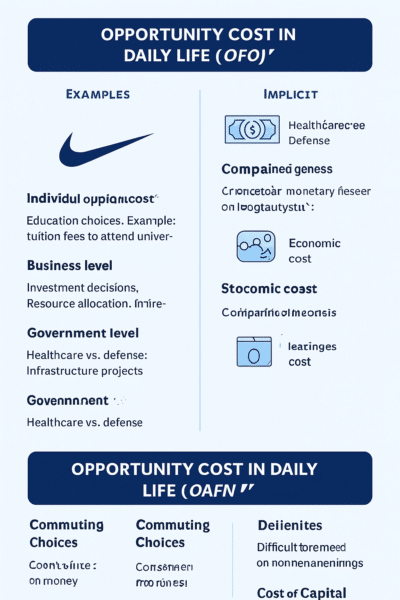
Individual Level
- Education Choices: A student choosing to attend university sacrifices the income they could have earned by working full-time during those years.
- Leisure vs. Work: Spending a weekend at the beach instead of freelancing means losing potential earnings.
- Consumption Choices: Buying a new car instead of saving for retirement represents a trade-off with long-term financial security.
Business Level
- Investment Decisions: A company investing in research and development for new products may forgo short-term profits from expanding existing product lines.
- Resource Allocation: If a factory produces shoes, the opportunity cost is the clothing it could have produced with the same resources.
- Hiring vs. Automation: Choosing to automate a production process instead of hiring check out this post on cost of production .workers involves trade-offs in flexibility, efficiency, and costs.
Government Level
- Healthcare vs. Defense: A government choosing to expand military spending sacrifices the potential improvements in healthcare and education.
- Infrastructure Projects: Building airports instead of roads reflects trade-offs in public needs.
- Subsidies: Providing agricultural subsidies to farmers may mean fewer resources for industrial development. check out economic subsidies here
Types of Opportunity Cost
Explicit Opportunity Cost
This involves direct, monetary payments. For example, paying tuition fees to attend university is an explicit cost. The forgone alternative—perhaps working and earning a salary—represents the opportunity cost.
Implicit Opportunity Cost
This refers to non-monetary sacrifices, such as time, effort, or lost convenience. For instance, if an entrepreneur spends time running their own business, the implicit cost is the salary they could have earned working for another company.
Accounting Cost vs. Economic Cost
Accounting Cost: Includes only explicit costs that are recorded in financial statements.
Economic Cost: Includes both explicit and implicit costs, making it a broader measure that captures opportunity cost.
Opportunity Cost in Daily Life
Opportunity cost is not confined to business or economics. It influences daily decisions.
Commuting Choices: Driving to work may save time but costs more in fuel, while taking public transport may be cheaper but costs time.
Diet and Health: Choosing fast food may save money and time but carries the opportunity cost of long-term health risks.
Relationships: Spending time with one person may mean missing out on interactions with others.
These examples highlight how opportunity cost is a universal principle guiding human choices.
Opportunity Cost in Business and Finance
Businesses rely on opportunity cost to evaluate projects, investments, and strategies. For example:
Capital Investment Decisions: A company with limited funds must choose between investing in new technology or expanding into new markets. The chosen option excludes the other.
Stock Market Investments: If an investor chooses to put money into bonds, the opportunity cost is the potential gains from stocks.
Cost of Capital: Firms often calculate the opportunity cost of capital to ensure funds are allocated where they can generate the highest return.
This approach ensures efficient use of resources and helps in achieving long-term growth.
The Role of Opportunity Cost in Economics
Opportunity cost forms the foundation of many economic theories, including:
- Production Possibility Frontier (PPF): The curve illustrates the trade-offs between producing different goods. Moving along the curve reflects opportunity costs of shifting resources.
- Comparative Advantage: Nations specialize in producing goods with the lowest opportunity cost, leading to more efficient global trade.
- Marginal Analysis: Economists use opportunity cost to evaluate the additional benefit versus the additional cost of an action.
Thus, opportunity cost is not just an abstract theory but a tool for understanding real-world economic dynamics.
How to Calculate Opportunity Cost
The general formula is:
Opportunity Cost = Value of Forgone Alternative – Value of Chosen Option
For example:
If you invest $5,000 in Stock A and it earns $500, while Stock B would have earned $800, the opportunity cost is $300.
If you spend a weekend on vacation instead of working overtime and earning $200, your opportunity cost is $200.
This calculation helps individuals and businesses evaluate whether their choices maximize value.
Opportunity Cost in Decision-Making
Understanding opportunity cost enables rational decision-making. By comparing benefits and sacrifices, people can:
Choose the most efficient use of time and money.
Avoid wasteful spending.
Prioritize long-term goals over short-term pleasures.
Maximize satisfaction and returns from scarce resources.
In essence, recognizing opportunity cost is about thinking critically before making choices.
Opportunity Cost and Public Policy
Governments constantly face opportunity costs in public policy. For example:
Allocating funds to defense may mean fewer hospitals.
Subsidizing fuel may reduce resources for renewable energy development.
Investing in rural development may delay urban infrastructure projects.
By acknowledging opportunity costs, policymakers can create more balanced and transparent budgets.
Limitations of Opportunity Cost
While opportunity cost is useful, it has some limitations:
Difficult to Measure: Non-monetary sacrifices such as happiness or satisfaction are hard to quantify.
Future Uncertainty: The benefits of forgone alternatives may be uncertain.
Subjectivity: Different individuals may perceive opportunity costs differently.
Despite these challenges, the concept remains vital in understanding trade-offs.
Additional Frequently Asked Questions (FAQ)
Q6: How does opportunity cost affect investment decisions?
It forces investors to consider what they could earn elsewhere, ensuring they choose the best possible return.
Q7: Can opportunity cost apply to time management?
Yes. Time spent on one activity means giving up another potentially valuable use of that time.
Q8: How does opportunity cost relate to comparative advantage?
A country has a comparative advantage when it produces goods at the lowest opportunity cost compared to others.
Q9: Is opportunity cost used in personal finance?
Absolutely. Decisions about saving, investing, borrowing, or spending always involve trade-offs.
Q10: How can students apply opportunity cost in daily life?
By prioritizing study over leisure when exams approach, recognizing that lost study time may cost grades and future opportunities.
Summary and Conclusion
Opportunity cost is the value of the next best alternative forgone when making a decision. It arises from the scarcity of resources and applies to individuals, businesses, and governments alike. From personal time management to billion-dollar investment strategies, opportunity cost shapes the way choices are made.
By carefully considering opportunity cost, people and institutions can use their resources more effectively, avoid regrets, and make better long-term decisions. Although it may not always be easy to measure, recognizing its role ensures that choices are deliberate and well-informed. scroll down to see more details
Opportunity cost is the value of the next best alternative that is forgone as a result of choosing one option over another. In other words, it is the cost of giving up the opportunity to choose another alternative.
For example, suppose you have $100 and you are trying to decide whether to invest it in stocks or bonds. If you choose to invest in stocks, the opportunity cost would be the potential return you could have earned by investing in bonds instead. Similarly, if you choose to invest in bonds, the opportunity cost would be the potential return you could have earned by investing in stocks.
Opportunity cost is an important concept in economics and business decision-making because it helps individuals and organizations make more informed choices by weighing the potential benefits and costs of different options. By understanding opportunity cost, individuals and organizations can make better decisions about how to allocate their resources, such as time, money, and labor.
If he chooses to buy the t-shirt and leave out the android phone, it then means that the opportunity costs of the t-shirt is the android phone which he did not buy
Definition of Opportunity cost
Definition: Opportunity costs is defined as an expression of cost in times of forgone alternatives. It is the satisfaction of one’s want at the expenses of another want. It refers to the wants that are left unsatisfied in order to satisfy another more pressing need.
Human wants are many, while the means of satisfying them are scarce or limited. We are therefore; faced with a problem where we have to choose one form a whole set of human wants; to choose one means to forgo the other, a farmer who has only two hundred naira (200.00) and want to buy a cutlass and a hoe may discover that he cannot get both materials and item for two hundred naira.
He would therefore have to choose which one to buy with the money he has. If he decides to buy a cutlass, it means he has decided to forgo the hoe. The hoe read simple farm tools here, is thus what he has sacrificed is the forgone alternative and this is what is referred to as opportunity costs should not be confused with Money cost refers to the total amount of money that is spent in order to acquire a set of goods and service.
For example, a customer who spent 6,200.00 to buy a pair of trousers has dispensed with cash. The 6,200.00 spent is the money cost.
Importance of Opportunity Cost
Opportunity cost is very important to individuals firms and governments. So lets take a look at the importance of opportunity cost to businesses, government, firms, organizations and to individual
- Importance of Opportunity Cost To individuals
- Wise choice: Opportunity cost enables individual to make wise choice between competing wants.
- Importance of Opportunity Cost to Efficient use of scarce resources:
It also assists individual to make maximum use of scarce resources relative to their unlimited wants.
- Importance of Opportunity Costs To the firms
- Rational decision: It assists the firm to make rational decisions about production process.
- Importance of opportunity costs to Techniques of production:
It also helps manufacturing industries in deciding the techniques of production, i.e. whether to adopt capital or labour intensive method of production.
- How the government of any country makes use of opportunity cost
- Preparation of budget: Opportunities cost helps the government in the preparation of budget, since it assists in efficient allocation of scarce resources to certain sectors of the economy.
Decision making process: It helps the government in making certain decisions, e.g. the priority areas that may require immediate attention, such as medical and education
Originally posted 2025-01-18 17:28:12.