
Types of Rock: Formation, Characteristics, and Uses
The types of rock that make up the Earth’s crust are fundamental to understanding the world beneath our feet. Every rock tells a story of formation, transformation, and use in everyday life.
In this post, we will explore:
The main types of rock
How each type is formed
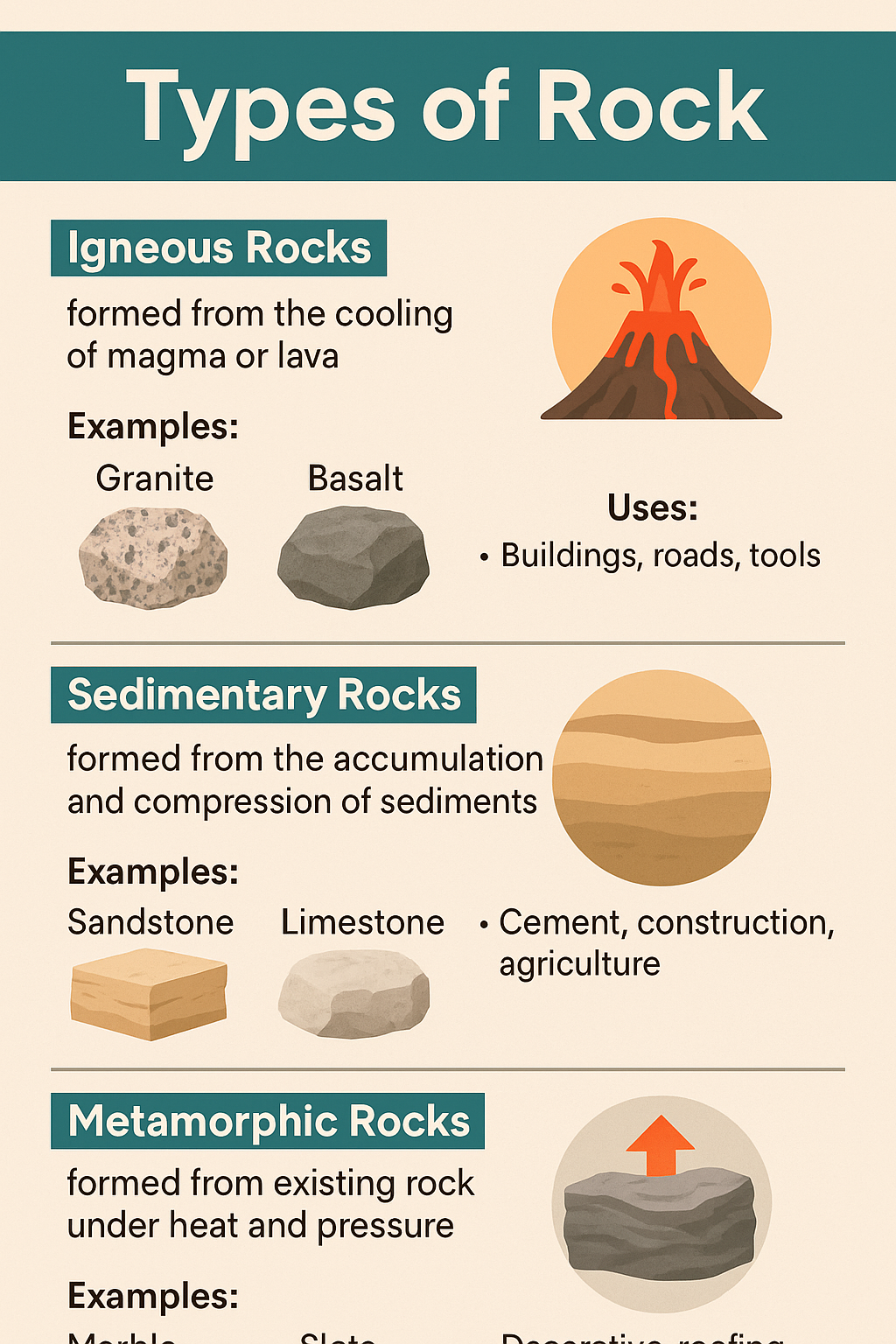
Common uses of each rock type
What Are the Three Main Types of Rock?
Geologists classify rocks into three main types of rock based on how they are formed:
- Igneous Rocks
- Sedimentary Rocks
- Metamorphic Rocks
Each of these types of rock has distinct properties, examples, and applications.
- Igneous Rocks
How They Are Formed:
Igneous rocks form when molten rock (magma or lava) cools and solidifies. This process can happen beneath the Earth’s surface or on it.
Intrusive Igneous Rock: Cooled slowly underground (e.g., Granite)
Extrusive Igneous Rock: Cooled quickly on the surface (e.g., Basalt)
Examples:
Granite
Basalt
Pumice
Obsidian
Uses:
This type of rock is widely used:
Granite: Construction, monuments, kitchen countertops.
Basalt: Road construction and as crushed stone.
Pumice: Cleaning products, beauty scrubs.
Obsidian: Cutting tools and ornamental objects.
- Sedimentary Rocks
How They Are Formed:
Sedimentary rocks develop from the compression of layers of sediments like sand, pebbles, shells, and clay over time.
Examples:
Sandstone
Shale
Conglomerate
Uses:
This type of rock plays a key role in industries:
Limestone: Cement making, agriculture (soil conditioner), glass production.
Sandstone: Paving, building material.
Shale: Bricks, tiles, and ceramics.
Conglomerate: Decorative stones in construction.
- Metamorphic Rocks
How They Are Formed:
Metamorphic rocks arise when existing rocks are exposed to intense heat and pressure, altering their original form without melting.
Examples:
Marble
Slate
Gneiss
Schist
Uses:
This type of rock is valued for strength and beauty:
Marble: Statues, flooring, architecture.
Slate: Roofing, flooring, chalkboards.
Gneiss: Building materials.
Schist: Landscaping stones.
Quick Comparison Table of the Types of Rock
Types of Rock Formation Process Common Examples Uses
Igneous Rocks Cooling of magma or lava Granite, Basalt Buildings, roads, sculptures
Sedimentary Rocks Compression of sediments Limestone, Sandstone Cement, agriculture, construction
Metamorphic Rocks Heat and pressure on existing rocks Marble, Slate Decorative, roofing, flooring
Importance of Understanding the Types of Rock
Recognizing the types of rock and their formation helps in industries like:
Construction
Mining
Agriculture
Art and Design
Each type of rock holds economic value and practical significance in daily human activities.
LIVER FLUKE
162. ECTO PARASITES
163. TICK
check out these recent posts
Originally posted 2025-07-04 17:29:19.