
Bulblets: Formation, Functions, and Uses in Plant Reproduction
Bulblets are small, immature bulbs that develop on a plant, usually attached to the base of a larger bulb or sometimes along the underground stem. They are an important means of vegetative propagation, allowing plants to produce genetically identical offspring without the need for seeds.
Structure of Bulblets
A bulblet is a miniature version of a bulb, composed of:
- Basal Plate – A short stem from which roots emerge.
- Fleshy Scales – Modified leaves that store nutrients.
- Shoot Apex – The growing point that will form leaves and flowers.
Formation of Bulblets
Bulblets develop through vegetative growth from the parent bulb.
Key steps include:
Initiation – Buds form at the base of the parent bulb.
Growth – Nutrients and carbohydrates accumulate in the bulblet.
Maturation – The bulblet reaches a viable size for planting.
Separation – Bulblets detach naturally or are separated manually for cultivation.
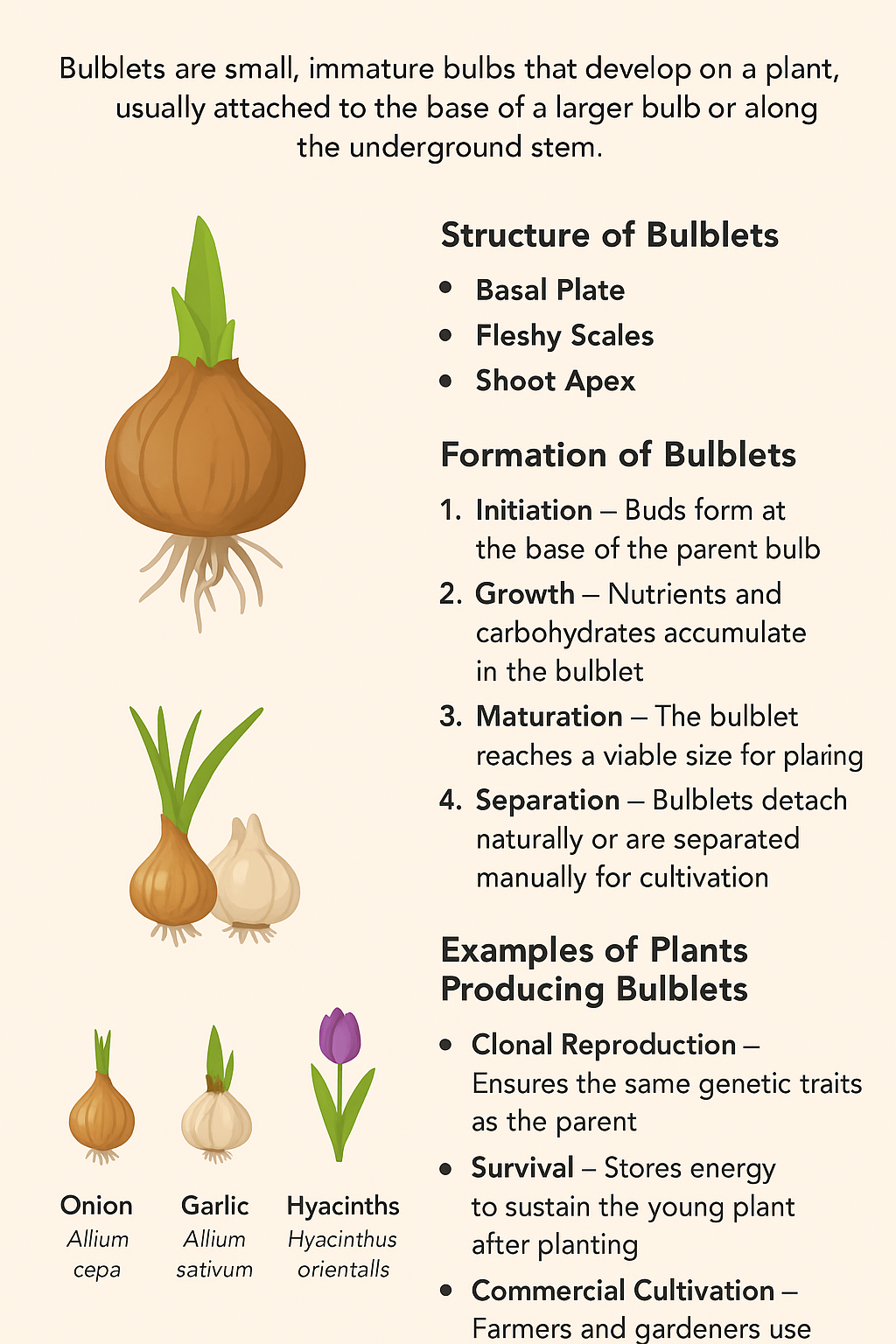
Examples of Plants Producing Bulblets
Onions (Allium cepa)
Garlic (Allium sativum)
Tulips (Tulipa species)
Hyacinths (Hyacinthus orientalis)
Biological Significance
Clonal Reproduction – Ensures the same genetic traits as the parent.
Survival – Stores energy to sustain the young plant after planting.
Commercial Cultivation – Farmers and gardeners use bulblets to produce large numbers of plants efficiently.
Advantages of Bulblets
- Guarantee of uniform crop traits.
- Faster maturity compared to seed-grown plants.
- High survival rate.
- Can be stored before planting.
Disadvantages of Bulblets
- No genetic variation, making crops vulnerable to diseases.
- Requires careful storage to avoid rot.
- Can lead to overcrowding if not separated.
Summary
Bulblets are miniature bulbs that serve as an effective reproductive strategy for many plants, ensuring quick growth, preservation of traits, and reliable crop production.
FAQs About Bulblets
- What is the main difference between bulbils and bulblets?
Bulbils usually form above ground in leaf axils, while bulblets develop below ground near the parent bulb. - Can bulblets grow into full plants?
Yes, with proper planting conditions, bulblets grow into mature plants. - How long should bulblets be stored before planting?
Typically, bulblets can be stored for a few weeks to months, depending on the species. - Are bulblets used in commercial farming?
Yes, especially in onion, garlic, and ornamental flower production. - Do bulblets need special soil?
Well-drained, nutrient-rich soil is ideal for bulblet growth. - Can bulblets survive harsh winters?
Some species are frost-hardy, but others require storage in controlled conditions. - How are bulblets separated from the parent plant?
They can be gently detached by hand during harvesting or replanting. - Do bulblets produce flowers in their first year?
In many species, bulblets first produce leaves and may flower in subsequent years. - Can bulblets spread unwanted plants?
Yes, if not managed, they can lead to overgrowth. - Are bulblets edible?
In crops like onions and garlic, bulblets are edible; in ornamental plants, they are usually not consumed.
Originally posted 2025-08-17 09:58:24.