
Biopolymer: Definition, Types, Properties, and Applications
Keyword: Biopolymer
Introduction
Biopolymers are natural polymers produced by living organisms. They are made from renewable biological sources such as plants, animals, and microorganisms, and are biodegradable, making them environmentally friendly alternatives to synthetic plastics.
From the cellulose in plant cell walls to the DNA in our cells, biopolymers play critical roles in both nature and technology.
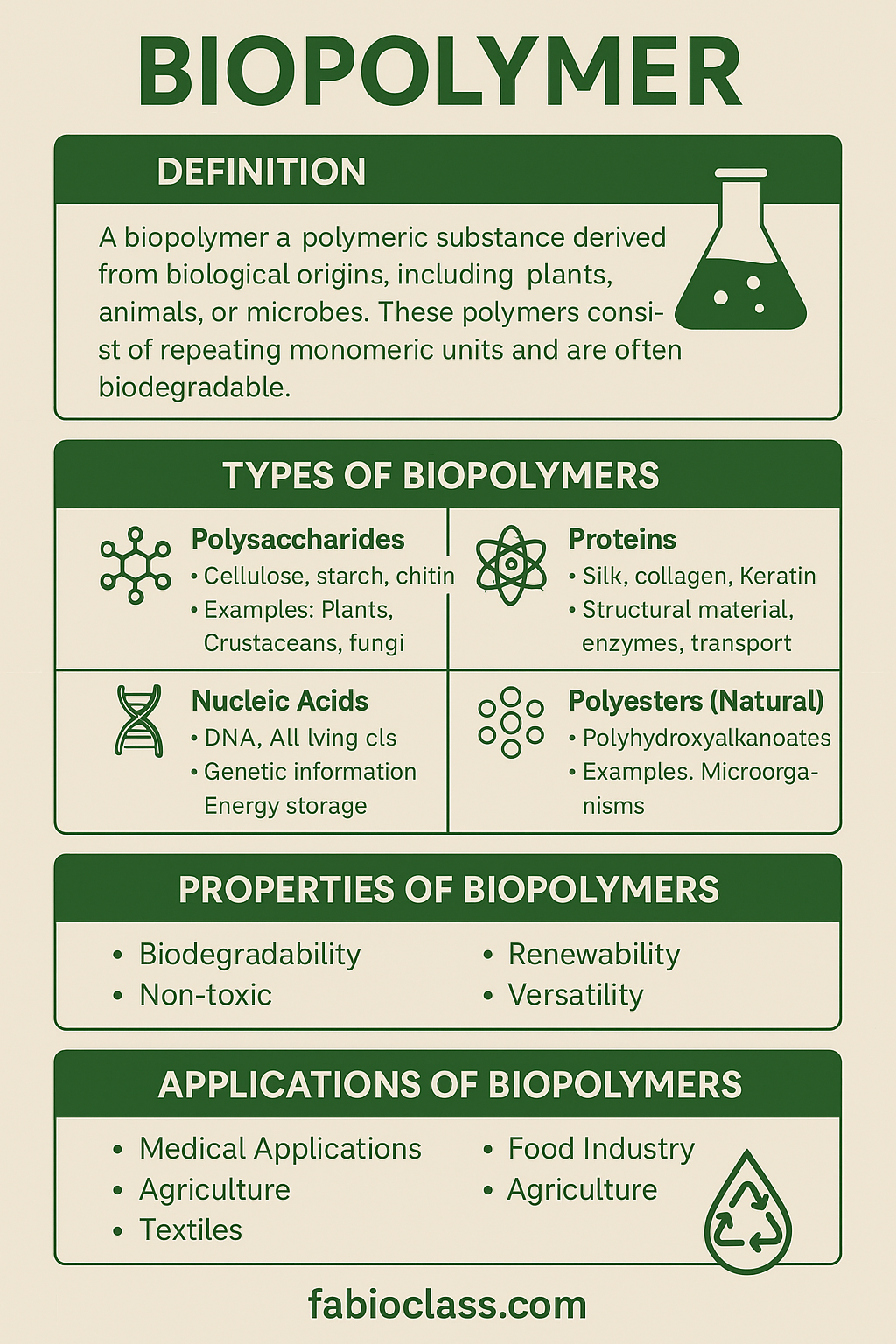
Definition of Biopolymer
A biopolymer is a polymeric substance derived from biological origins, including plants, animals, or microbes. These polymers consist of repeating monomeric units linked by covalent bonds and are often biodegradable.
Types of Biopolymers
- Polysaccharides
Examples: Cellulose, starch, chitin.
Source: Plants, crustaceans, fungi.
Functions: Energy storage, structural support.
- Proteins
Examples: Silk, collagen, keratin.
Source: Animals and plants.
Functions: Structural material, enzymes, transport.
- Nucleic Acids
Examples: DNA, RNA.
Source: All living cells.
Functions: Genetic information storage and transfer.
- Polyesters (Natural)
Examples: Polyhydroxyalkanoates (PHAs).
Source: Microorganisms.
Functions: Energy storage in bacteria.
Properties of Biopolymers
Biodegradability – Easily broken down by microorganisms.
Renewability – Sourced from plants and animals.
Non-toxic – Safe for humans and ecosystems.
Versatility – Can be used in packaging, medicine, textiles, and agriculture.
Applications of Biopolymers
- Medical Applications
Sutures and wound dressings.
Drug delivery systems.
Tissue engineering scaffolds.
- Food Industry
Biodegradable packaging.
Edible films for food preservation.
- Agriculture
Biodegradable mulch films.
Slow-release fertilizers.
- Textiles
Clothing fibers like silk and wool. check out this post on cotton cultivation
- Environmental Uses
Reducing plastic waste pollution.
Compostable household items.
Advantages of Biopolymers
Reduce dependence on petroleum-based plastics.
Lower environmental pollution.
Renewable and sustainable production.
Can be engineered for specific properties.
Disadvantages of Biopolymers
Higher production costs.
Sometimes less durable than synthetic plastics.
Require specific conditions for biodegradation.
Future of Biopolymers
The global demand for biopolymers is increasing as industries shift toward sustainable solutions. Research is focusing on improving strength, heat resistance, and cost-effectiveness to compete with traditional plastics.
Summary
Biopolymers are nature’s answer to the environmental challenges caused by synthetic plastics. With applications in medicine, packaging, textiles, and agriculture, they are paving the way toward a greener future.
10 Frequently Asked Questions (FAQs)
- What is a biopolymer?
A natural polymer derived from plants, animals, or microbes. - Are all biopolymers biodegradable?
Most are, but some require specific conditions for degradation. - What are the main types of biopolymers?
Polysaccharides, proteins, nucleic acids, and natural polyesters. - Can biopolymers replace plastic?
Yes, in many applications such as packaging and disposable products. - Is cellulose a biopolymer?
Yes, it is the most abundant biopolymer on Earth. - What industries use biopolymers?
Medicine, agriculture, food, textiles, and environmental management. - Are biopolymers expensive?
Currently more expensive than plastics, but costs are falling. - Can biopolymers be synthetic?
They are mostly natural, but some can be artificially synthesized from natural monomers. - Do biopolymers harm the environment?
No, they are eco-friendly and biodegradable. - What is the future of biopolymers?
Growth in sustainable manufacturing, eco-packaging, and medical innovations.
Originally posted 2025-08-11 20:04:12.